
When people hear the phrase “Bay Area technology economy,” Silicon Valley is often the first place that comes to mind. However, the technology economy of Northern California extends far beyond Santa Clara and San Mateo counties. Alameda County has developed an increasingly important role in the region’s technology, research, manufacturing, professional services, and innovation landscape.
Located in the East Bay, Alameda County combines major urban centers, established business communities, universities, research institutions, industrial areas, transportation networks, and residential neighborhoods. Cities such as Oakland, Berkeley, Fremont, Hayward, Alameda, San Leandro, Dublin, Pleasanton, and Livermore each contribute different strengths to the county’s broader economy.
Technology is also much broader than software development. Today’s technology economy includes artificial intelligence, cybersecurity, cloud computing, advanced manufacturing, robotics, biotechnology, health technology, data analytics, digital services, research, telecommunications, and information systems. These industries increasingly overlap with traditional sectors such as manufacturing, health care, transportation, education, logistics, government, retail, and professional services.
This makes Alameda County’s technology economy especially interesting. Technology is not simply creating a new group of companies in the county. It is also changing the way existing businesses operate, how government delivers services, how students prepare for careers, and how workers develop new skills.
Alameda County’s own technology planning recognizes the importance of innovation, digital transformation, cybersecurity, workforce development, and adapting to rapidly changing technologies. Its current strategic planning also connects technology with broader goals involving economic opportunity, infrastructure, public services, and community needs.
For residents, workers, entrepreneurs, students, and local business owners, understanding this changing environment can provide a clearer picture of where Alameda County’s economy may be heading.
Why Alameda County Is Becoming an Important Technology Hub
Alameda County benefits from being part of the larger San Francisco Bay Area while maintaining its own distinct economic identity. Its location places communities throughout the county within reach of San Francisco, Silicon Valley, major universities, research institutions, airports, transportation networks, and a large regional customer base.
That geographic position is particularly valuable for companies that need access to skilled workers.
Technology companies depend heavily on people with specialized knowledge. Software developers, engineers, scientists, data analysts, cybersecurity professionals, designers, project managers, technicians, researchers, and business specialists all contribute to technology-driven organizations.
Alameda County’s large population and diverse employment base provide companies with access to a broad labor market. At the same time, nearby universities and research organizations contribute to the development of specialized talent.
The county also has a strong existing industrial and professional foundation. This means a technology company does not necessarily have to build an ecosystem from the ground up. It can interact with manufacturers, health care organizations, transportation companies, professional-services firms, educational institutions, government agencies, and small businesses that already operate throughout the East Bay.
That interconnected economy is one of Alameda County’s major strengths.
Instead of thinking of technology as a separate industry, it is more useful to view it as a layer that increasingly connects different parts of the local economy.
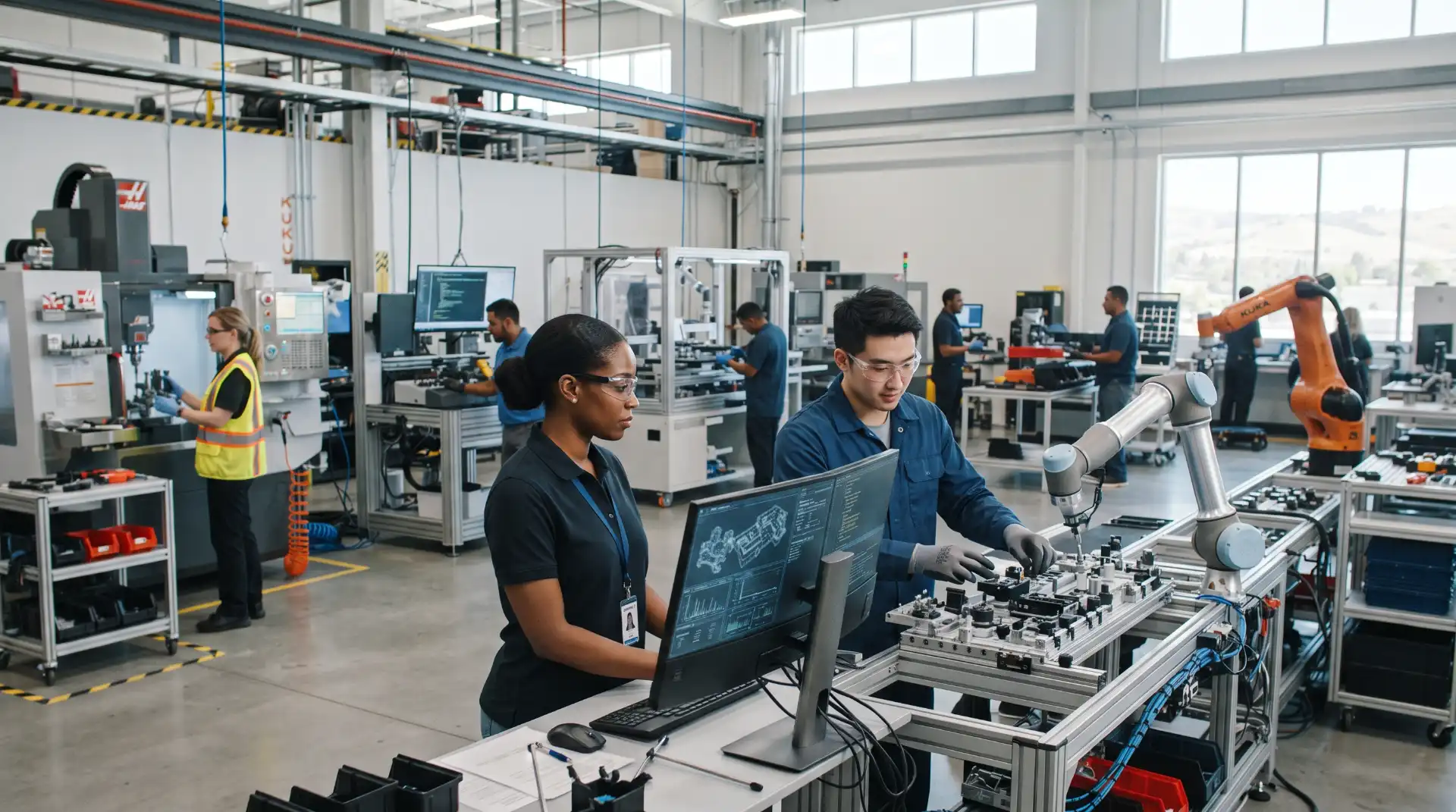
Fremont and the Connection Between Technology and Manufacturing
Fremont is an important example of how Alameda County’s technology economy differs from the traditional Silicon Valley model.
The city has developed strong connections to advanced manufacturing, engineering, electronics, industrial technology, and technology-related businesses. Its location also places it close to the Silicon Valley labor market while providing access to the broader East Bay.
Modern manufacturing increasingly depends on technology.
Factories can use robotics, computer-controlled equipment, sensors, automated inspection systems, artificial intelligence, data analytics, and digital design tools. These technologies can change the skills that manufacturers need and create demand for engineers, technicians, programmers, equipment specialists, maintenance professionals, and other technical workers.
This means manufacturing and technology should not be treated as completely separate sectors.
A modern manufacturing facility can function as a highly technical workplace even when its primary product is physical rather than digital.
Fremont’s economic development therefore illustrates an important trend within Alameda County. The future of technology may involve not only software applications and online services but also physical products, robotics, transportation technology, energy systems, medical devices, and advanced industrial equipment.
For workers, this creates career opportunities that extend beyond traditional software engineering.
For local businesses, it creates demand for specialized suppliers, consultants, equipment providers, logistics companies, engineering firms, and technical service providers.
Oakland’s Role in the Alameda County Technology Economy
Oakland contributes another important dimension to the county’s technology economy.
As a major urban center, Oakland has a diverse business environment that includes professional services, health care, education, logistics, retail, restaurants, nonprofit organizations, manufacturing, creative businesses, and technology-related companies.
Technology can support all of these sectors.
A small Oakland restaurant may rely on online ordering, digital reservations, electronic payment systems, social media marketing, accounting software, and delivery platforms. A professional-services company may depend on cloud computing, video conferencing, cybersecurity tools, customer relationship management systems, and digital document platforms.
A manufacturer may use automated equipment and data systems, while a nonprofit organization may depend on digital fundraising, online communications, and donor-management software.
This broad adoption of technology makes Oakland an important part of the county’s technology ecosystem even when individual businesses do not describe themselves as technology companies.
Oakland’s cultural and business environment also contributes to its appeal for entrepreneurs and creative professionals. The city’s independent businesses, neighborhoods, arts organizations, restaurants, and community institutions create a diverse environment in which new businesses can develop.
Readers interested in the city’s broader identity can also explore the existing Exploring Oakland: Culture, Food, History, and Community Experiences article on this site. Explore Oakland: Culture, Food, History, and Community Experiences
That broader look at Oakland helps demonstrate why the city’s technology economy is connected to its larger cultural and commercial environment.
Berkeley’s Research and Education Connection
Berkeley provides another important part of Alameda County’s innovation ecosystem.
The city is strongly associated with higher education, research, science, entrepreneurship, and intellectual development. Educational institutions can contribute to technology economies in several ways, including preparing workers, conducting research, supporting entrepreneurship, and connecting students with employers.
The relationship between universities and technology companies can be especially important in industries where specialized scientific or technical knowledge is required.
Research can lead to new ideas, discoveries, methods, and technologies. Entrepreneurs can then develop commercial applications for some of those ideas, while established companies may use research to improve products and services.
This process does not always happen quickly.
Scientific research can take years to move from an academic environment into a commercial application. Nevertheless, the presence of universities and research institutions helps create a culture in which innovation can develop over time.
For Alameda County, this educational foundation provides another reason why the technology economy is broader than a collection of software companies.
Livermore and Alameda County’s Scientific Research Economy
Livermore adds another important element to the county’s technology and research landscape.
The city’s scientific and research institutions contribute to Alameda County’s concentration of technical expertise. Research organizations can support highly skilled employment while also creating connections with educational institutions, suppliers, contractors, laboratories, and other businesses.
Scientific research can have economic effects beyond the facilities where it takes place.
Researchers need specialized equipment, technical services, professional support, transportation, facilities, information systems, and other resources. This creates connections between research institutions and local businesses.
The presence of scientific research also contributes to the development of a workforce with specialized skills in science, engineering, computing, laboratory work, and technical management.
This creates another layer within Alameda County’s technology economy.
Artificial Intelligence Is Changing the Local Technology Landscape
Artificial intelligence is one of the most significant forces affecting the technology industry in 2026.
AI is being incorporated into software development, data analysis, customer service, cybersecurity, scientific research, marketing, manufacturing, health care, finance, transportation, and government operations.
Alameda County is not separate from these changes.
The county’s own 2026 budget materials discuss artificial intelligence and automation as forces reshaping the technology industry. The document also notes restructuring and employment reductions at several major technology companies.
This creates an important distinction between technology innovation and employment growth.
A technology industry can continue developing rapidly while individual companies reduce certain positions, restructure departments, or change the skills they require.
For Alameda County workers, this means adaptability is becoming increasingly important.
Employees may need to learn how to use AI-powered tools rather than simply compete against them. A marketing professional may use AI for research and content analysis. An engineer may use AI-assisted design tools. A customer-service representative may work alongside automated systems. A data analyst may use AI to process information more efficiently.
The impact therefore extends far beyond people whose job titles contain the word “technology.”
Technology Jobs Are More Diverse Than Many People Realize
When people imagine technology jobs, software developers and computer engineers often come to mind first.
Those positions remain important, but the technology economy includes many other career paths.
Cybersecurity professionals protect digital systems and information. Data analysts help businesses interpret information. Project managers coordinate complex technology initiatives. Technical writers explain complicated systems. User-experience professionals help improve digital products.
Engineers may work in manufacturing, energy, transportation, health care, construction, or environmental technology.
Technicians may maintain equipment and infrastructure. Network specialists support communications systems. Laboratory professionals work with scientific technologies. Sales professionals help companies market specialized products.
There are also opportunities in human resources, finance, marketing, operations, customer support, procurement, administration, and management within technology-focused companies.
This diversity matters because it means people with different educational backgrounds can participate in the technology economy.
A technology career does not necessarily require becoming a software engineer.
Workforce Development Is Critical to Alameda County’s Future
Technology changes quickly, which means workforce development becomes an important part of maintaining a competitive economy.
Workers may need opportunities to learn new software, technical systems, digital tools, data skills, cybersecurity practices, and other capabilities throughout their careers.
Alameda County’s technology planning emphasizes the importance of developing a workforce that can adapt to changing technologies. Its Information Technology Department’s 2026 People Plan describes goals involving recruitment, retention, training, professional development, internships, and technology skills.
This approach is relevant beyond county government.
Businesses throughout Alameda County face similar challenges. Employers need workers who can learn new tools and adjust to changing workplace requirements.
Training can take many forms.
Some workers may return to college. Others may complete professional certificates, attend workforce-development programs, participate in employer training, or learn through practical experience.
Community colleges, trade programs, universities, workforce organizations, employers, and government agencies can all contribute to this process.
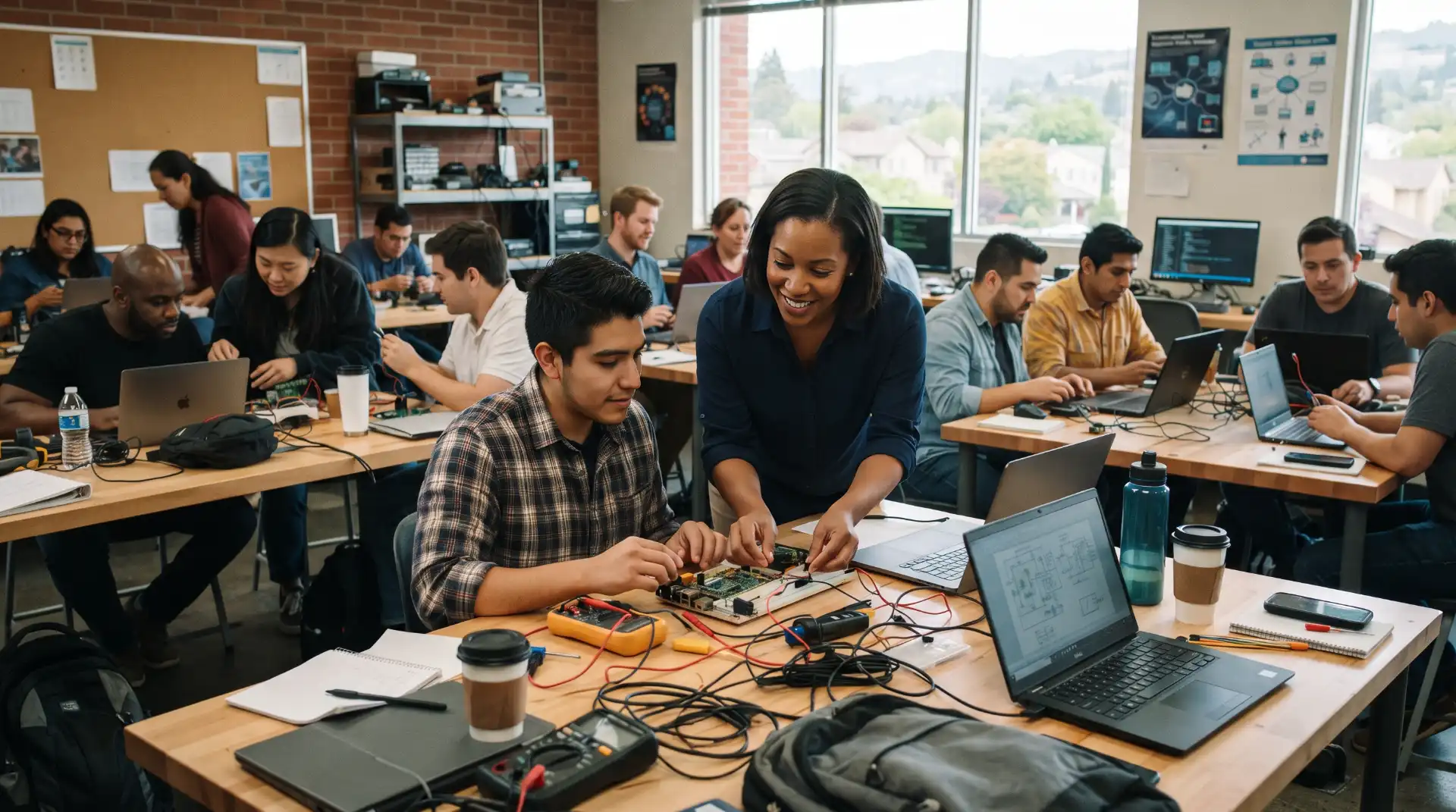
Student Internships Can Build the Next Generation of Technology Workers
Students represent an important part of Alameda County’s future technology workforce.
Early exposure to technology careers can help students understand what different jobs actually involve. Classroom education provides important foundations, but internships and hands-on experiences can demonstrate how those skills are used in real workplaces.
Alameda County’s Information Technology Department has a student internship program that provides opportunities for students to gain experience with areas such as applications, websites, support services, networking, and security.
Programs like this can help bridge the gap between education and employment.
They can also introduce students to technology careers that they may not have considered previously.
A student interested in computers might discover cybersecurity. Another might become interested in data analysis. Someone interested in engineering could explore advanced manufacturing. A student interested in public service could discover how technology supports government operations.
The broader lesson is that technology education can lead in many directions.
Small Businesses Are an Important Part of the Technology Economy
Large technology companies often receive most of the attention, but small businesses are equally important to the local technology ecosystem.
A small business may use technology every day without considering itself part of the technology economy.
A restaurant might rely on digital ordering and payment systems. A retailer may use e-commerce and inventory software. A construction company may manage projects through cloud-based applications. A real estate professional may use digital marketing and customer-management platforms.
A local medical practice may depend on electronic records and appointment systems.
These businesses create demand for technology services.
They may need website developers, IT consultants, cybersecurity specialists, digital marketing professionals, software providers, telecommunications services, and technical support.
This creates a local business cycle in which technology companies support traditional businesses while traditional businesses provide customers for technology companies.
Technology and Local Entrepreneurship
Alameda County’s location also creates opportunities for entrepreneurs.
A new company can potentially reach customers throughout the East Bay while remaining connected to the broader Bay Area market.
Entrepreneurs can benefit from the county’s proximity to universities, research institutions, transportation systems, business communities, and technology centers.
However, starting a technology company still involves substantial challenges.
Entrepreneurs need a product or service that solves a real problem. They also need customers, financing, employees, management expertise, and a sustainable business model.
Technology alone does not guarantee success.
For local entrepreneurs, one potential advantage of Alameda County is the diversity of problems that businesses can address.
Transportation, health care, logistics, energy efficiency, cybersecurity, climate resilience, housing services, education, and small-business technology are all areas where technology can potentially be applied to practical challenges.
Government Technology Is Part of the Local Innovation Economy
Government is another major part of the technology story.
Alameda County’s Information Technology Department manages technology systems that support county agencies and public services. The department’s current project portfolio includes application modernization, cloud-based tools, hybrid workplace technology, communications modernization, and other digital initiatives.
Government technology can have an impact on residents’ everyday experiences.
Online applications, digital forms, electronic communications, data systems, public websites, and virtual services can make government interactions more accessible and efficient.
The county’s strategic planning also identifies cybersecurity and digital transformation as important priorities.
This creates demand for technology professionals in the public sector.
Software specialists, cybersecurity professionals, project managers, data experts, network specialists, systems administrators, and technology managers can all contribute to public-sector operations.
Government technology also creates opportunities for private companies that provide software, consulting, infrastructure, cybersecurity, communications, and other technical services.
Cybersecurity Is Becoming More Important for Local Businesses
As businesses become more dependent on technology, cybersecurity becomes a basic business requirement.
A cybersecurity incident can affect a company’s operations, customer information, finances, reputation, and ability to continue operating.
This applies to large corporations, but it also applies to small businesses.
A small company may hold customer information, payment information, employee records, business documents, contracts, financial information, and other valuable data.
Protecting these systems requires more than installing antivirus software.
Businesses increasingly need secure passwords, multifactor authentication, employee training, software updates, backups, access controls, secure networks, and incident-response plans.
Alameda County’s technology strategy specifically identifies cybersecurity as a continuing priority as the county modernizes its systems and services.
That focus reflects a larger trend affecting businesses throughout the United States.
Cybersecurity is no longer only an issue for technology companies. It is part of operating almost any modern organization.
Advanced Manufacturing Is Becoming More Technology Driven
Alameda County’s manufacturing sector provides another example of technology’s broader economic impact.
Manufacturing facilities increasingly rely on automated systems, robotics, sensors, data collection, digital design, computer-controlled machinery, and advanced quality-control systems.
This transformation can change the types of workers manufacturers need.
Instead of relying entirely on traditional production roles, companies may need more technicians, engineers, programmers, equipment specialists, robotics professionals, and data-oriented employees.
This does not mean traditional manufacturing skills disappear.
Instead, workers may need to combine practical manufacturing knowledge with digital skills.
The result can be a workforce that understands both the physical production process and the technology used to manage it.
For Alameda County, this creates an opportunity to connect its established manufacturing base with its technology and research capabilities.
Health Care and Technology Are Increasingly Connected
Health care is another major industry where technology continues to expand.
Hospitals, clinics, laboratories, medical offices, and health organizations depend on increasingly sophisticated information systems.
Electronic health records, diagnostic equipment, laboratory systems, scheduling platforms, cybersecurity, telehealth services, and data analytics are all examples of technology that can support modern health care.
Technology companies can also develop medical devices, software platforms, data tools, laboratory technologies, and services designed for health organizations.
Because Alameda County has a large health care sector, the relationship between technology and health care creates opportunities for both established organizations and new businesses.
This is another example of why the county’s technology economy should not be measured only by the number of software startups.
The Connection Between Technology and Tourism
Technology also affects Alameda County’s visitor economy.
Travelers increasingly depend on digital maps, online reservations, mobile applications, electronic payments, travel websites, review platforms, and social media when planning trips.
Hotels and tourism businesses use digital systems to manage reservations, communicate with guests, market their properties, and coordinate operations.
Visitors exploring the county can also use technology to discover restaurants, parks, historic locations, museums, and local businesses.
For travelers interested in staying in Alameda while exploring the broader Bay Area, the site’s existing guide to Hawthorn Suites by Wyndham Oakland/Alameda provides additional information about the accommodation and its location. Hawthorn Suites by Wyndham Oakland/Alameda Guide
The connection between tourism and technology demonstrates another way digital tools influence the local economy.
Technology Does Not Replace Alameda County’s History
Although the county is looking toward the future, its technology economy exists within communities with long histories.
Fremont, for example, contains historic places that predate today’s technology industries by centuries.
The site’s Mission San José Fremont History and Visitor Guide explores one of the county’s important historic landmarks and provides additional context for understanding Fremont’s development. Mission San José Fremont History and Visitor Guide
The coexistence of historic sites and modern technology businesses illustrates Alameda County’s broader identity.
The county is not replacing its history with technology.
Instead, old communities and new industries exist alongside one another.
Historic neighborhoods, cultural institutions, manufacturing areas, research facilities, technology offices, parks, and residential communities all contribute to the character of the East Bay.

Technology Can Help Traditional Businesses Compete
Technology adoption can be especially valuable for established local businesses.
A small retailer can use an online store to reach customers beyond its immediate neighborhood. A restaurant can use digital ordering to make transactions more convenient. A contractor can use project-management software to organize employees and schedules.
A professional-service company can use cloud-based tools to collaborate with clients.
These changes may appear small, but thousands of businesses adopting useful technology can collectively influence the county’s productivity and competitiveness.
Technology therefore does not have to mean creating a new startup.
It can also mean helping an existing business operate more effectively.
For Alameda County, supporting technology adoption among existing companies can be an important part of economic development.
The Challenges Facing Alameda County’s Technology Economy
Growth in technology also creates challenges.
The Bay Area has a high cost of living, which can make it difficult for some workers to live close to major employment centers.
Housing costs can influence where workers live, while transportation costs and commuting times can affect employment decisions.
Technology-sector volatility is another challenge.
Artificial intelligence and automation can create new opportunities while changing or eliminating certain tasks. Companies may reorganize their operations as technology improves.
Alameda County’s 2026 budget materials specifically discuss AI-driven restructuring and automation in the technology industry, including recent layoffs at major companies.
This means workers cannot necessarily depend on one set of skills remaining valuable forever.
Continuous learning is becoming increasingly important.
The county also faces the challenge of ensuring that technology benefits are broadly accessible.
If digital tools become essential for employment, education, health care, government services, and business, residents need reliable access to technology and opportunities to develop digital skills.
Digital Access and the Future Workforce
A technology-driven economy depends on more than highly skilled engineers.
It also requires communities where people can access education, employment opportunities, digital services, and training.
The county’s broader strategic planning includes goals related to employment, workforce development, entrepreneurship, innovation, infrastructure, and access.
These issues are connected.
A student who cannot access reliable technology may have difficulty completing assignments. A job seeker without digital skills may struggle with modern applications. A small business without adequate technology may find it harder to compete.
Digital access is therefore increasingly connected to economic opportunity.
For Alameda County, technology policy and economic development are becoming closely linked.
What Students Should Know About Technology Careers
Students interested in technology do not need to choose one narrow career path immediately.
The technology economy includes many different occupations.
Someone interested in mathematics might explore data science or analytics. Someone interested in physical systems might consider engineering or advanced manufacturing. A person interested in problem-solving could explore cybersecurity.
Students who enjoy communication may find opportunities in technical writing, product management, technology marketing, or customer success.
Students interested in science may explore biotechnology, laboratory technology, environmental technology, or research.
The most useful preparation may be learning how to adapt.
Technology will continue changing, and the specific tools used by employers five or ten years from now may be different from today’s tools.
The ability to learn new systems can therefore be one of the most valuable skills a worker develops.
What Local Business Owners Should Watch
Local business owners should pay attention to how technology is changing their industries.
Artificial intelligence, automation, digital marketing, cybersecurity, cloud computing, and online commerce can all affect how companies operate.
The goal should not necessarily be to adopt every new technology.
Instead, business owners can focus on identifying problems that technology can realistically solve.
If administrative work consumes too much time, automation may help. If customers have difficulty finding a business online, improving its digital presence may help. If employees struggle with communication, better collaboration tools may be useful.
Technology is most valuable when it solves a real business problem.
The Role of Innovation in Alameda County’s Economic Future
Alameda County’s strategic planning places innovation alongside broader priorities involving employment, infrastructure, sustainability, and public services.
The county’s Vision 2036 framework includes a goal of fostering entrepreneurship and innovation that supports sustainable economic growth. It also identifies partnerships with educational institutions and support for innovative incubators as part of preparing for the future.
This approach recognizes that economic development is not only about attracting large corporations.
A strong local economy also depends on entrepreneurs, small businesses, workers, educational institutions, and community organizations.
Innovation can happen inside a startup, but it can also happen inside a hospital, manufacturing facility, school, government agency, nonprofit organization, or neighborhood business.
That broader understanding of innovation may be particularly relevant to Alameda County.
What the Next Several Years Could Bring
The next several years will likely bring continued changes to Alameda County’s technology economy.
Artificial intelligence will affect many occupations. Cybersecurity will become increasingly important. Businesses will continue moving services and data into cloud-based environments.
Advanced manufacturing may adopt more robotics and automated systems. Health care will continue incorporating digital tools. Government agencies will continue modernizing public services.
At the same time, technology employment may remain volatile in some areas.
Some companies may expand while others reduce staff. New businesses may emerge around technologies that are not yet widely adopted. Existing companies may change their business models.
For workers, this creates a need for flexibility.
For educators, it creates a need to keep training programs connected to changing employer requirements.
For businesses, it creates a need to evaluate technology investments carefully.
For local government, it creates a need to balance innovation with security, accessibility, cost, and public needs.
Alameda County’s Technology Economy Is a Regional Story
The future of Alameda County’s technology economy cannot be separated from the broader Bay Area.
Oakland is connected to San Francisco and the region’s urban economy. Berkeley contributes education and research. Fremont connects advanced manufacturing with technology. Livermore contributes scientific research. Dublin and Pleasanton provide business and professional services.
Hayward, San Leandro, Alameda, Newark, Union City, and other communities contribute workers, businesses, customers, institutions, and infrastructure.
Together, these communities create an economic network that is more diverse than the image of Silicon Valley alone.
That diversity may be one of Alameda County’s defining advantages.
Technology can interact with manufacturing, health care, education, transportation, tourism, government, retail, and professional services.
This creates opportunities for businesses that may never call themselves technology companies.
Why Local Businesses Matter to the Future
Large companies may attract attention, but local businesses help determine how technology affects everyday communities.
A small company that adopts better technology can improve productivity. A local technology provider can create specialized employment. A new startup can introduce a service that solves a local problem.
A manufacturing company can use automation to improve production. A restaurant can use technology to reach customers. A nonprofit can use digital tools to expand its services.
Each of these examples contributes to the broader technology economy.
The strength of Alameda County’s technology ecosystem will therefore depend not only on major employers but also on thousands of smaller organizations that adopt, provide, and develop technology.
How Residents Can Participate in Alameda County’s Technology Economy
Residents do not need to work for a technology company to participate in the county’s technology economy.
Workers can develop digital skills relevant to their current careers. Students can explore internships and technical education. Business owners can identify practical technology improvements.
Entrepreneurs can look for local problems that technology might help solve.
Residents can also learn about employment and training programs available through government agencies, educational institutions, and workforce organizations.
The key is recognizing that technology is becoming part of nearly every industry.
A person working in health care, manufacturing, hospitality, transportation, education, construction, retail, finance, or government may already be participating in the technology economy without using that label.
Conclusion: Alameda County’s Technology Future Is Broad and Diverse
Alameda County’s growing technology economy is not simply a story about software companies or startups.
It is a broader transformation affecting the way businesses operate, how workers develop skills, how students prepare for careers, and how government delivers public services.
Oakland’s urban business environment, Berkeley’s educational and research resources, Fremont’s advanced manufacturing connections, Livermore’s scientific activity, and the professional and business communities throughout the county all contribute to the larger ecosystem.
Artificial intelligence and automation are creating new opportunities while also changing employment patterns. Cybersecurity is becoming increasingly important. Digital transformation is affecting government and private businesses. Workforce development is becoming essential as workers adapt to new technologies.
At the same time, local businesses remain an important part of the story.
Technology can help a small business reach new customers, manage operations, improve security, and compete in a changing marketplace. It can help manufacturers improve production, health care organizations manage information, and government agencies provide services more efficiently.
Alameda County’s current technology strategy recognizes these changes. The county identifies innovation, digital transformation, cybersecurity, technology modernization, and workforce development as important components of its future planning.
For residents and businesses, the most important takeaway is that the technology economy is not happening somewhere else.
It is already part of Alameda County.
The future will depend on how effectively the county’s communities, businesses, educational institutions, workers, entrepreneurs, and public agencies adapt to new technologies while maintaining the local character and economic diversity that make the East Bay distinctive.
As Alameda County continues to evolve, its technology economy will likely remain closely connected to the industries and communities that have shaped the region for generations.